Review of: Battling the Gods: Atheism in the Ancient World, by Tim Whitmarsh

How do we define atheism today? What exactly constitutes an atheist? Although I am not a believer in magical sky gods, I avoid describing myself as an atheist, which not only has a Battling the Gods Atheism in the Ancient Worldbit of an arrogant ring to it but these days is additionally burdened by the negative fallout from the militant atheism – actually “anti-theism” – of a Richard Dawkins or a Bill Maher, as of late further tarnished by blatant Islamophobia. On the other hand, agnostic sounds a bit tentative, so I coined my own term, “dogmatic skeptic,” to sum up my outlook in this regard. My point here is that while there are lots of variations of the religious experience, there may be just as many varieties and degrees of non-belief (un-belief?). Armed with a stunningly encyclopedic knowledge of ancient times, renowned Classicist Tim Whitmarsh sets out in Battling the Gods: Atheism in the Ancient World to establish that atheism is not only a post-Enlightenment phenomenon but has as well a solid foundation in the remote past.

There are problems almost from the very start. Once more, how do we define atheism? If one rejects established religion, does that establish them as atheist? Hardly.  Plato rejected the Olympian pantheon, but he believed in mysterious perfect forms and a vague supreme being, so he was hardly atheist. And we know a lot about Plato from the relatively large body of his work that has survived. In contrast, most of what we know about the rest of the ancient world is fragmentary, so much interpretation is required, and whenever possible Whitmarsh interprets to suit his thesis. What if all we had were portions of Martin Luther’s Ninety-five Theses challenging the Roman Catholic Church on indulgences? We might conclude that Luther was an atheist, but we would of course be very wrong.

I would take this one step further: there remains a heated debate in some circles of twenty-first century American historiography as to the religious beliefs, or lack thereof, of the various Founders, with some even asserting that Jefferson or Madison were atheists, and others vigorously challenging that notion. In this case, we have a vast collection of writings both by the subjects in question and by those who knew them intimately, yet much dispute remains. This is further complicated by the fact that spiritual beliefs can change dramatically over a lifetime; many become more devout as they grow older and mortality looms. A perfect example is Hamilton, a devoted Presbyterian in his youth who seemed to lose interest in religion entirely during the Revolution; he later briefly flirted with Deism (according to biographer Ron Chernow), and yet on his deathbed spoke with great passion about his commitment to a loving god.  These men lived only a little more than a couple of centuries ago, yet there remains great ambiguity.  How can we then reach back thousands of years with fragmentary evidence and make pronouncements with such certainty?

Whitmarsh takes us on an extremely well-written and often delightful tour of the philosophical and religious realms of the ancient Mediterranean in his studied attempt to turn up committed atheists, but leaves me mostly unconvinced, not because they did not exist but because after all he presents little incontrovertible evidence of their presence. The author himself hints at them more than locating them in their respective haystacks.  At one point, Whitmarsh cites the famous rhetorical flourish of the pre-Socratic philosopher Xenophanes: “Now if cows, horses or lions had hands, and were able to draw with those hands and create things as humans do, horses would draw gods in the form of horses, and cows in the form of cows, and create bodies just like they had.” Yet, on the very next page he concedes that Xenophanes, a believer in “one god, greatest among gods and mortals, not at all like mortals in body or thought,” is hardly the atheist the former quotation might suggest. [p60-61] Battling the Gods is replete with such material.  I have no reason to doubt that there were atheists at the very dawn of the human experience, but I remain unconvinced that they ever comprised more than a very tiny minority. I would also grant that this number may have been greater during the heyday of ancient Greek and Roman scientific inquiry, but if in the twentieth-first century at the height of modern science and medicine so many billions stubbornly cling to supernatural beliefs, we should not be surprised if these numbers were dramatically larger in the days when the forces of earthquakes and lightning remained objects of some great and terrible mystery.

I was a bit troubled by the treatment of Socrates in this work, whom Whitmarsh buzzes around tenuously in dozens of references.  We all know that Socrates was charged with impiety (More specifically according to Xenophon’s Memorabilia for “refusing to recognize the gods acknowledged by the state, and importing strange divinities of his own; he is further guilty of corrupting the young.”) but there is a consensus among historians that this was but a pretext to punish the great gadfly for his former association with members of the “Thirty Tyrants,” the Spartan-supported reactionary regime that came to briefly rule Athens after her defeat in the Peloponnesian War, and especially his one-time pupil, Critias, their cruel leader.  Whitmarsh makes much of the fact that the existence of the capital charge of impiety had to imply that there was a wealth of the impious, but I find him careless in failing to underscore that Socrates was hardly an example of the same.

The charges levied against Socrates, however, do raise an issue that Whitmarsh barely explores but perhaps buttresses his thesis: if you could likely be put to death simply for challenging religious orthodoxy – never mind atheism – in an unusually open society like the Athenian polis, few would advertise such proclivities nor leave written confirmation of the same. Thus, as they say, absence of evidence is hardly evidence of absence.  Susan Jacoby’s marvelous book Freethinkers resurrects the relatively large cast of agnostics that publically populated nineteenth century America, but they lived in a free society where they could perhaps be shunned but not jailed or burned at the stake.  You would hardly expect to find something similar elsewhere on the globe back then, or in such places as Saudi Arabia today.  Atheist remains a dirty word in the United States in 2016, but at least in Massachusetts you cannot be stoned to death for proclaiming yourself one.

Remarkably, while I often found Battling the Gods to lack focus and ultimately concluded that Whitmarsh failed to substantively make his case, I still enjoyed reading this book for the author’s wide acquaintance and articulate commentary upon philosophy, religion and ancient history. I would caution that some background in these disciplines is requisite in order for the reader to properly place the narrative in context, as this volume is hardly suitable for the general audience.  Finally, I would note that while I agree with Whitmarsh that atheism is not purely a modern phenomenon, I would maintain that in the past its adherents likely remained lurking quietly at the periphery, even much more so than they do today.

Review of: An Ape’s View of Human Evolution, by Peter Andrews

In the search for a common ancestor, Peter Andrews points out in An Ape’s View of Human Evolution, we should not expect a hominid that resembles living great apes or humans, only one that contains certain traits that are present in both populations today. For instance, since the lack of a tail is a defining characteristic to each group, we would expect that our common ancestor would have lost its tail, as well. This is a fascinating perspective that immediately brought to mind something in an entirely different field that while unrelated is somewhat analogous: linguists searching for the common origins to the hundreds of Indo-European languages that are today spoken across more than forty percent of the globe have constructed a framework ancestral language known as Proto Indo-European (PIE); our living languages are descended from it with detectable ties to root words and grammar. Elements of PIE are still extant in languages as disparate as English and Hindi, just as there are elements of that ancient hominid in both chimps and humans today. Andrews, a renowned anthropologist who once studied under the legendary Louis Leakey and went on to spend much of his career at London’s Natural History Museum, has brought a lifetime of scholarship to bear in this study of fossil apes and their environments that offers clues to what this common progenitor might have been like.

The surviving “great apes” consist of humans, orangutans, gorillas, and the two species of chimpanzees and bonobos that are our closest relatives. Collectively they and their extinct ancestors are known as hominids. (Gibbons are also apes, but are classified separately as “lesser apes.”) Human ancestors subsequent to the human-chimpanzee divergence are known more specifically as hominins. Thus, that enigmatic and elusive most recent common ancestor represents the parent stock to both humans and chimps. The search for this forebear is complicated by the scarcity of hominid fossils. The once famous claim that all hominid fossils could be displayed on a billiard table is both wildly exaggerated and certainly obsolete, as thousands of such fossils have been recovered in recent decades. Still, these remain no less rare, and much of what we do have is fragmentary. I have always especially been struck by the paucity of hominin fossils, but it turns out that this represents a veritable abundance next to the scant traces of fossil apes that have come down to us. Andrews wonders aloud about the rich array and potential numbers of extinct apes that might have once walked the earth, while he painstakingly takes the reader through a carefully detailed examination of the fossil evidence in hand, much of it from the Miocene Epoch (roughly 23 to 5 MYA).

I am grateful to the Cambridge University Press for providing me with a copy of this book for review, but I might not have requested it had I known that it was such a highly specialized work. I have followed studies in human evolution for many years, but my training is in history not paleontology, so I found portions of the book a challenging read, especially the many chapters given to descriptive fossil morphology, pregnant with anatomical detail. An Ape’s View of Human Evolution is clearly not intended for a general audience, although the reader with a strong background in evolutionary studies can well appreciate the first six chapters as Andrews reviews what is known about fossil apes in general, and artfully reconstructs the respective environments that hosted them. His discussion of the isotopic signatures that reveal the kinds of food that nourished them – C4 plants vs. C3 grasses – is a reminder of the wealth of detail today’s science can bring to bear in evaluating fossil evidence. And this is, of course, a field open to constant revision: Andrews notes that the once popular view that knuckle-walking, the unique form of locomotion seen in chimps and gorillas, might be a kind of forerunner to bipedalism and therefore present in a common ancestor, has largely been refuted by studies that seem to indicate that knuckle-walking developed similarly but independently in each of these great apes and is therefore not a key to their common evolution. In fact, it turns out that knuckle-walking does not even establish a sister relationship between chimpanzees and gorillas; like wings that developed independently in birds and bats, this unusual type of locomotion is analogous rather than homologous. [p25-26]

This is great stuff! Unfortunately, the narrative thread abruptly breaks off as subsequent chapters are devoted almost exclusively to fossil ape morphology, which felt more like the kind of material suitable to an appendix. In a similar vein, I was reminded of the middle portion of David Anthony’s otherwise magnificent The Horse, the Wheel and Language, when it appears as if Anthony has incongruously inserted a sizeable chunk of his archaeological dig notes smack dab into the center of the chronicle. Fortunately, Anthony later resumes the narrative. This cannot be said of Andrews, who only very briefly revisits earlier themes in his final section, which merely consists of some twenty pages of text. It is clear that the morphological material that makes up roughly half of this volume is intended to buttress reasoned arguments for what we can expect to find in a common ancestor, but a stronger concluding chapter that connected all of the dots with greater clarity would have been most welcome. Still, as noted earlier, this book is intended for a specialized audience and the abundance of material included by Andrews in this scholarly work is no doubt a welcome addition to the literature in this exciting field as we continue to seek and evaluate critical evidence to chart the course of human evolution.

Review of: Hornswogglers, Fourflushers & Snake-Oil Salesmen: True Tales of the Old West’s Sleaziest Swindlers, by Matthew P. Mayo

I take my responsibility as an “Early Reviewer” very seriously, so when I obtain a book under such circumstances, I feel an obligation to both the author and the Early Reviewers program to read it through cover-to-cover in order to fairly evaluate it. Absent that strong sense of commitment, I would certainly have abandoned Hornswogglers, Fourflushers & Snake-Oil Salesmen: True Tales of the Old West’s Sleaziest Swindlers, by Matthew P. Mayo, somewhere around page twelve. Instead, I agonizingly forced my way through all of its twenty-two chapters and two hundred seventy-seven pages of character sketches – which unfortunately simply reinforced my first impression.

In fairness to the author, I am probably the wrong audience for a book like this, as reader or reviewer. Still, in fairness to me it is billed as American History – which is why I initially requested it – and the back cover duly claims it as History/US-19th Century. But more importantly, in fairness to actual historians who painstakingly research, analyze, interpret and write books about history, Hornswogglers hardly qualifies as history at all, except perhaps in the very broadest sense in that its content is concerned with the past. This book is written for a popular rather than a scholarly academic audience, but I do not object to that; I commonly read both kinds of histories and am comfortable evaluating each on their respective merits. I might, in general, take exception to the absence of notes, which is sloppy for either kind of work, but in this case that is really the very least complaint a reviewer could raise. To my mind, this is simply a dreadfully bad book on a variety of levels.

Deafening alarm bells went off on the third page of the “Introduction” as Mayo nonchalantly reveals that: “At various points I used poetic license by adding dialogue and supporting characters where firsthand accounts were scarce.” [p xiii] Really??? I must admit a sense of astonishment: this is my first experience with an author of an ostensible work of history who has freely and insouciantly confessed to the manufacture of conversations as well as some of the individuals peopling his chronicle. We have a name for books that fall into this category – historical fiction – a perfectly legitimate genre that has produced magnificent works by the likes of Michael Shaara, Mary Renault and Gore Vidal. But these are emphatically not styled as history.

By way of exception, I will grant a willingness to give a pass to Thucydides, who in his magisterial The History of the Peloponnesian War clearly imagines exchanges between key individuals that he could not have witnessed. But nothing in Hornswogglers comes up even close to the level of the “Melian Dialogue.” In fact, concocted inner-monologues and dialogues characterize at least eighty percent of the narrative, and much of it reeks with simply bad writing, of the “dark and stormy night” variety. Moreover, it lacks all measure of authenticity, especially because it tries so hard to be authentic. Imagine, if you would, the kinds of scripts written for popular “Grade-B” Westerns in the Hollywood of the 1940s, with a character actor such as Walter Brennan cast as a grizzled prospector downing a foamy beer in a saloon while spouting the derivative canned vernacular that was a typical ingredient of an old-fashioned celluloid horse opera – much of Hornswogglers is a poorer echo of that!

And what of the author, Matthew P. Mayo? The back cover bio proudly touts that he “is a Spur Award-winning writer” (an award for writers of Western fiction), and goes on to note that: “He roves the highways and byways of North America . . . in search of high adventure, hot coffee, and tasty whisky.” His website adds only that he is an Eagle Scout and an “on-screen expert for a popular BBC-TV series about lost treasure.” Whether he has had a formal education or any training for writing proper history is conspicuous in its absence. My guess would be not so much.

I suppose there are those who would be entertained by some of the colorful character vignettes in this book, but I would suspect that those like myself concerned with the documentary history of the American West would not be a part of this audience. A “hornswoggler” is apparently defined as a deceiver who dupes a hapless victim: I cannot help but feel that I was hornswoggled into reading this book.


Review of: King Leopold’s Ghost: A Story of Greed, Terrorism and Heroism in Colonial Africa, by Adam Hochschild

Tragically, inhumanity on an epic scale is not reserved to a single time or a single place. Which is why Francis Ford Coppola could so effortlessly pluck Kurtz out of Joseph Conrad’s Africa and deposit him into the Southeast Asian milieu of Apocalypse Now. The original Kurtz of Heart of Darkness was indeed a fictional character, but nevertheless served as an emblem of authenticity for historic individuals, actual events, a specific geography and an almost unimaginable cruelty that has been virtually forgotten by much of the world, even by the descendants of the victims. In King Leopold’s Ghost: A Story of Greed, Terrorism and Heroism in Colonial Africa, Adam Hochschild forces us to remember.

During the mad scramble for Africa in the late nineteenth century, European powers ruthlessly carved up the continent into colonial possessions irrespective of historic boundaries or tribal loyalties. But the Congo, where Conrad’s visit found inspiration for Kurtz, was not one of those colonies. It was rather quite remarkably and singularly the vast personal fiefdom of Belgium’s King Leopold II, a constitutional monarch with almost no political power at home, who managed to create his very own African empire and milked it for everything he could with a terror machine worthy of envy by the worst later twentieth century totalitarians. If this is a book of heroes and villains – although Hochschild is too much a student of nuance and complexity to paint with such a broad brush – Leopold was indeed a great villain. Still another was the famed explorer Henry Morton Stanley, of Stanley and Livingstone fame, who manufactured his own identity, managed to serve and subsequently desert from both sides in the American Civil War, routinely brutalized natives on expedition, had such a streak of sadism that he once fed his dog its own tail that he had severed – and through his efforts nearly single-handedly secured the Congo for Leopold to menace and exploit.

But these two pale in comparison to the agents of Leopold’s rule who squeezed the territory and its hapless population for every last drop of wealth, from an initial focus on ivory to the exploding market for rubber. A review such as this is too limited in scope to contain even a summary of all of the atrocities committed in this regard, and it would take a thick tome of single-spaced text in a tiny font to list all of the otherwise nameless and colorless Kurtz’s who dispassionately carried out the long litany of crimes against humanity that characterized Leopold’s rule of the Congo, often magistrates or members of what was called the Force Publique. Some of the more notable mounted heads on poles or collected skulls as souvenirs, inspiring Conrad, but most – like Hitler’s bureaucrats or Stalin’s executioners – were easily forgotten anonymous murderers who quietly went about their sanguinary duties. Hochschild cites Primo Levi’s observations of his Auschwitz experience: “Monsters exist, but they are too few in number to be truly dangerous. More dangerous are the . . . functionaries ready to believe and to act without asking questions.” [p121]

Leopold successfully disguised his appropriation of a huge chunk of Africa for his personal domain through a disingenuous campaign against slavery by Arab traders. But through a clever sleight of hand it was Leopold who enslaved the native population, compelling them to forced labor in unimaginably inhumane conditions, chained together by the neck and routinely punished with hundreds of lashes by a rawhide whip known as a chicotte, while conducting mass campaigns of extermination against those who resisted or ran away. The Force Publique were issued rations of bullets and expected to return with either unused shells or the severed right hands of those they had killed. Thousands of hands were collected, in some cases from living human beings. It was a terror on a scale never before seen on the continent.

There were also heroes, white and black, although like most heroic figures in history they remained unrewarded in life. Leopold’s forces were quite formidable, as were his public relations resources. Still, eventually an odd alliance of brave souls – a black American missionary, a British agitator and journalist, and a British Consul with grave secrets – gradually brought to light the misdeeds that plagued the Congo and spurred an international effort towards redress. The latter, a descendant of the nineteenth century anti-slavery crusade, was the last great Pan-European human rights movement of that era and ultimately proved successful, more or less, by forcing Leopold to divest himself of the Congo, which became a colony of Belgium and saw the end of the worst kinds of abuses that once ran rampant there. This movement is also largely forgotten, along with the cruelties it sought to relieve, eclipsed in human memory by the greater horrors of World War I and sympathy for the victimized and overrun Belgium.

The exploitation of the Congo continued, however, although the terror was much diminished. Few even among the reformers recognized the greater crimes of colonialism and the abuses it spawned. Towards the end of this outstanding book, Hochschild reminds us that although Europe rose in righteous indignation at Leopold’s cruelties, it turned a blind eye to much of the rest of the crimes against humanity that raged in colonial Africa and beyond, including the 1904 mass extermination of tens of thousands of Hereros in German South West Africa, today’s Namibia. The British massacre of aborigines in Australia hardly caused a stir. Few noticed as the United States pursued a counter-guerrilla effort in the Philippines “that killed 20,000 rebels and saw 200,000 more Filipinos die of war-related hunger or disease.” [p282] There were plenty of villains to go around, usually masked by the bureaucracy of the state rather than the figure of a single individual such as Leopold.

As for the heroes, they are forgotten also. The journalist Edmund Morel (who resurfaces in Hochschild’s magnificent book, To End All Wars) is later imprisoned for his loud opposition to England’s involvement in World War I. The Congo experience acted to springboard former British Consul Roger Casement into anticolonial agitation that crossed the line in a wartime collaboration with Germany that sought to effect Irish independence; he later served as an inspiration for Nehru but was smeared for his covert homosexuality and ended his life on the gallows. Black missionary William Sheppard, disgraced for extramarital affairs, returned to an America of second class citizenship; a white woman in his Virginia hometown reminisced that: “He was such a good darky. When he returned from Africa he remembered his place and always came to the back door.” [p283]

In the Congo, the institution of the Force Publique also persisted. When the era of colonialism ended just as the Cold War was heating up, the CIA sponsored a coup that resulted in the overthrow and death of Congolese independence leader Patrice Lumumba, who was seen as unfriendly to western interests. The thug recruited as a key agent in this effort was Joseph-Desiré Mobutu, a former NCO in the Force Publique, who came to power and – rewarded by US support for his staunch anti-communism – for decades afterwards terrorized and bankrupted his country. In this sense, King Leopold’s ghost is still with us.

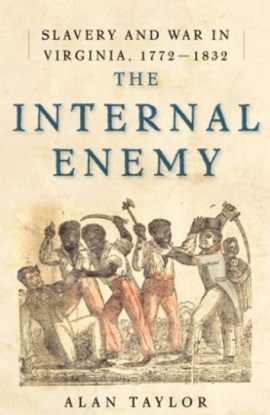
Review of: The Internal Enemy: Slavery and the War in Virginia 1772-1832, by Alan Taylor

Every now and again I read a nonfiction book that fits neatly into the geography of multiple areas of scholarship that I have been pursuing, reinforcing previous ground covered, rounding out the sharp edges of probes made into unexplored territory, while bringing an original and entirely new perspective to certain corners of the terrain. Such is the case for the superlative Pulitzer Prize winning volume, The Internal Enemy: Slavery and the War in Virginia 1772-1832, by noted scholar Alan Taylor, whom I consider one of the greatest living historians of early American history. While The Internal Enemy focuses on the experience of the War of 1812 in the Chesapeake, it actually surveys a much wider arena – an especial talent of Taylor as a historian – which is why I found that it touches upon so many areas that I have been studying.

The “internal enemy” of the book’s title is the slave population that the planter aristocracy of the early Republic somewhat uncomfortably but stubbornly considered essential to their way of life, even while often privately confessing their revulsion for the “peculiar institution.” Their descendants would sometimes come to deny the humanity of their human property, and argue on spurious religious and moral grounds that the master-slave relationship was beneficially enshrined in the natural order of things, but at this stage justifications are clumsy at best, and perhaps best summarized by Jefferson’s much cited “wolf by the ear” agonized cop-out. (“But, as it is, we have the wolf by the ear, and we can neither hold him, nor safely let him go. Justice is in one scale, and self-preservation in the other.”)

Despite contemporary accusations by some that we are applying unfair “political correctness” when judging the founding generation, Taylor reminds us that these guys knew that they had their arms wrapped around a great evil and nevertheless chose to abide it. The planter St. George Tucker, central to this narrative, acknowledges the incongruity of the ideals of the American Revolution and the institution of slavery, noting that “we were imposing upon our fellow men, who differ in complexion from us, a slavery ten thousand times more cruel than the utmost extremity of those grievances and oppressions.” No less a patriot than Patrick Henry “conceded that the system was as repugnant to humanity as it is inconsistent with the bible, and destructive to liberty.’ But Henry never freed his own slaves due to ‘the general inconveniency of living without them.’ Slaves comprised so much property in Virginia that they could not be freed without impoverishing white men and ruining their creditors.” [p35-36] This portion of the narrative recalls for me the fine book I read last year, Dominion of Memories: Jefferson, Madison & the Decline of Virginia, by Susan Dunn [reviewed by me here: https://regarp.com/2015/02/09/review-of-dominion-of-memories-jefferson-madison-the-decline-of-virginia-by-susan-dunn/], which explores the failure of the founding generation of planters to solve the problem of human chattel slavery and how that led to the decline of Virginia in the antebellum era. Taylor adds further nuance and complexity to the subject and thus deftly rebuts any attempt to give a pass to those whose soaring rhetoric on liberty failed to address their deep complicity in its antithesis, which was the foundation of their economic life.

Alan Taylor tends to personalize history, and as in his previous works The Internal Enemy carefully studies not only individuals but entire families. Despite his misgivings, it turns out that St. George Tucker ultimately reconciled himself to plantation slavery, but in a great twist of irony his stepson Charles Carter was of an abolitionist bent, and pronounced his desire to free his share of their mutual human property. Carter was thus ever after viewed by the rest of his clan with the kind of suspicion and disdain that a family today might direct towards a son and heir who was a thief or a heroin addict. [p229-30] Taylor aptly translates this into unsettling contemporary terms: “Seeing no other choice, most Virginians maintained slavery as their duty
. . . It is too easy for modern readers to feel superior by blaming slavery on the ‘bad people’ of another time and region. Slavery reveals how anyone, now as well as then, can come to accept, perpetuate, and jus­tify an exploitative system that seems essential and immutable. After all, we live with our own monsters.” [p83]

As a historian, Taylor often shines by forcing the reader to view something we think we know very well through a completely different lens, and he does not disappoint in The Internal Enemy. For example, Jefferson was proud of his achievements in the early Republic of overturning time-honored traditions of primogeniture and entail, which formerly had granted title to the eldest son and required estates to be passed down intact. Historians have often credited the Jefferson “revolution” in this regard because it led to a greater economic democratization over time. But Taylor neatly highlights the unintended consequences. One of the cruelest aspects of American slavery was the arbitrary separation of families when members were sold away to other plantations, sometimes at great distance; the end of entail made that far more common: “Entails often had attached slaves to their estates, which barred the owners from selling them. Although certainly not meant to benefit the slaves, that feudal restriction inhibited the breaking up of their families by sale. Under the reformed laws, the division of estates tedded to divide enslaved families among multiple heirs. The changes benefited younger sons, entrepreneurs, and creditors, but not the enslaved people treated as liquid capital.” [p46]

Taylor’s previous outstanding work, The Civil War of 1812: American Citizens, British Subjects, Irish Rebels, & Indian Allies [reviewed by me here: https://regarp.com/2015/10/01/review-of-the-civil-war-of-1812-american-citizens-british-subjects-irish-rebels-indian-allies-by-alan-taylor/] treats the largely disastrous American attempts to take Canada during the war. The Internal Enemy showcases British revenge for Canada through their punishing attacks on the Chesapeake, which the Virginia planter class felt most painfully. Just as the centrality of slavery undeniably defines the later Civil War, it is the centrality of slavery that determines Virginia’s response to the British assault. Already deeply suspicious of a central government with too much authority, and despite the fact that it was the most prominent scions of their planter class – first Jefferson and now Madison – serving as the new nation’s Chief Executives – Virginia prized its sovereignty along with its slaves. And these slaves also already inspired great fears among their owners. In fact, throughout the antebellum era across the vast southern geography where slavery thrived, slave rebellions were extremely rare, but the exaggerated possibilities ever overshadowed the jittery planters. Just as ancient Spartan armies hesitated to venture far from home for long periods lest their helots rise up, so too elite Virginians were less willing to invest manpower in armies to protect them from British incursions than in militias to protect them from imaginary slave uprisings. At the same time, they were loath to draw upon the vast human resources in their slave population to buttress their defensive posture against the invaders, although blacks had served with some distinction in the Revolutionary War. Already there was the root of the feeble claim that later echoed in the Civil War a half century later that blacks by virtue of their race were incapable of successful military service. Despite experience and common sense, enlistment of blacks, slave or free, was stubbornly resisted.

The British put a lie to this ungrounded theory by upping the ante. Not only did they vigorously encourage and abet slaves to run away to British ships, but they soon put them to impressive use as marines against their former masters. The greatest fears of the planters – that the invaders would incite slave rebellions – never came to pass, not only due to moral objections to such tactics (despite generalized British antipathy for slavery) but also because of self-interest: slaves still served as the chief labor force in often grueling conditions in British colonies in the West Indies.   But there was little reluctance to the undermining of the wealthy Virginia aristocracy by encouraging slaves to flee and then helping them to return to aid the escape of family members. Racism led many British officers to doubt the capabilities of black soldiers, but this was soon overcome as the former slaves, wearing British uniforms over their lash-scarred backs, proved brave and able in combat.

Slavery could be cruel and barbaric, but conditions varied just as human beings vary. Not all planters mistreated their chattel property, but yet many slaves that lived relatively well in servitude did not hesitate to flee when the opportunity arose, to the sometimes great puzzlement of their former masters who had become conditioned by their own delusional propaganda to be surprised that few would choose slavery – even when benign – over freedom. They coped with such rejection by persuading themselves that the Brits were resorting to compulsion to force loyal servants to abscond. The British responded by summoning such masters to visit their ships and invite their former slaves back into bondage. Unsurprisingly, there were not many takers.

There is far more to this excellent book than any review could properly encapsulate. If Taylor can reasonably be faulted, it is that sometimes his books are too long and too pregnant with detail. In the case of The Internal Enemy, the concluding chapters, which serve as a bridge to the next phase of the antebellum era, could perhaps have been attenuated.  Still, that hardly detracts from the well-written compelling narrative that relates a truly fascinating and little-known chapter of a little-known war – one that came to presage events that led to another much more familiar war some several decades hence. I would highly recommend this book to all students of American history.

Note: I have reviewed other works by Alan Taylor here:

Review of: American Revolutions: A Continental History, 1750-1804, by Alan Taylor

Review of: The Civil War of 1812: American Citizens, British Subjects, Irish Rebels, & Indian Allies by Alan Taylor

Review of: Thomas Jefferson’s Education, by Alan Taylor

Review of: American Republics: A Continental History of the United States, 1783-1850, by Alan Taylor

Review of: American Civil Wars: A Continental History, 1850-1873, by Alan Taylor

Review of: This Republic of Suffering: Death and the American Civil War, by Drew Gilpin Faust

Despite recommendations from those in tune with my interests, I went out of my way to avoid reading This Republic of Suffering: Death and the American Civil War, by Drew Gilpin Faust. Not only did the topic strike me as too gloomy and depressing, but I questioned the value of a book-length treatment of it. Then fate intervened and a copy came to me from an anonymous yet perspicacious “Secret Santa” via the annual holiday “Santathing” event sponsored by LibraryThing, the splendid online community especially fashioned for book nerds like me. Now I felt obligated.

As it turned out, This Republic of Suffering proved to be the perfect punctuation mark to my self-assigned intensive study of the Civil War during the sesquicentennial years. Over that time, I read some two dozen books on the conflict and its related themes, listened to countless hours of audio lectures in the car, watched film documentaries, visited battlefields – even digitized a rediscovered trove of Civil War correspondence and memoirs for a local museum, and spent a weekend seminar with legendary National Parks historian Ed Bearss that included tours of Antietam and Gettysburg. What could be missing?

As eminent historian and Harvard University president Drew Gilpin Faust brilliantly reminds us in this consequential study, what we have carelessly overlooked are the main characters: the sea of dead on both sides that totaled somewhere around 620,000 – about two percent of the nation’s population at the time, and a number equal to all dead in all other American wars through the Korean War! And these deaths did not simply epitomize a national tragedy, but they each represented a series of widespread individual tragedies for grieving mothers, fathers, wives, children and other members of extended families who were themselves victims of the Civil War even if they spent the war years hundreds or thousands of miles from the scenes of carnage that manifested these dead relations. This was a tangible and painful reality for millions of Americans touched by the war from a distance, but one that somehow had become lost to history until Faust neatly resurrected it here. It has been estimated that there have been in excess of fifty thousand books written on the Civil War since 1861, so it is somewhat astonishing when one is published that brings an entirely new perspective to what has been such an exhaustive study, but such is Faust’s triumph with This Republic of Suffering.

When we look back on mid-nineteenth century America from our twenty-first century standpoint, we cannot help but observe the prevalence of death for our relatively recent ancestors, in the explosive rates of infant mortality, in the numbers of women who perished in childbirth, in the much shorter average lifespans for those who lived in a time before modern medicine. But the inhabitants of that time could not see into the future. These grim realities were typical for their world. What was not typical, however, was the sudden loss of hundreds of thousands of men, most in their prime of life, over a brief four-year period. Two-thirds of these casualties may have succumbed to disease rather than bullets, but dead was dead, and these dead represented a significant segment of an entire generation that would be conspicuous in their absence for many decades after Appomattox. Faust deftly explores how this impacted both individual families and the nation at large, and how the survivors coped with such massive losses in practical, emotional and spiritual terms. Until This Republic of Suffering, this critical chunk of American history has been largely forgotten.

In the antebellum era, most Americans died at home rather than in today’s more commonly antiseptic hospital setting. Faust notes that there was a strong notion of an ars moriendi, a “Good Death,” that saw the end of life as a righteous path to heaven. The dead were tended to by their families; there were religious services and there was burial. The war changed all that. As Faust reveals, in the days before dog tags and databases, huge numbers of victims of munitions or measles went unidentified, leaving question marks and a profound lack of closure for thousands upon thousands of families whose soldier boys never returned home. The task of seeking such closure was a significant priority after the war’s end, but so was the recovery of the remains, known and unknown, for proper reburial. For the victorious north, whose Union dead typically fell so far from home, this became both a private and a coordinated federal campaign. Embalming, then in its infancy, and sealed coffins capable of long distance shipment, all came into their own. So did the concept of great cemeteries to house the dead and memorialize them. And while charlatans who claimed to communicate with the other side preyed on many pitiful, grieving families, the more benign comforts of traditional religion and spirituality were also challenged and had to be refashioned for a different age that presided over losses of such magnitude in this cataclysmic war.

The Civil War still resonates to this day, which perhaps accounts for its ongoing fascination for us. Every great book about that war speaks to us for our own time, and this is true of This Republic of Suffering, as well, which contains a telling side note that seems to reinforce the notion that while the north won the war, it was indeed the south that won the peace. While I was reading this book, controversy was raging over the removal of Confederate monuments in southern cities. Those who sought to retain these often awkward shrines claimed that to remove them would be to dishonor Confederate dead. Yet ironically, as Faust reveals in her narrative, at least some of the north’s sense of urgency for recovering and relocating the bodies of the fallen was based upon the widespread reports of the deliberate defilement of Union remains in the states of the former Confederacy.  Edmund B. Whitman, charged by the United States with heading up the effort to locate federals for reburial, noted that “he had witnessed the ‘total neglect’ or ‘wanton desecration’ of Union graves by a southern population whose ‘hatred of the dead’ seemed to exceed their earlier ‘abhorrence of the living.’” [p228]

This unpleasantness was to be set aside, along with much else, in the great reconciliation that marked the end of the nineteenth century, reestablishing legitimacy for the unfortunately “redeemed” south while trampling upon the rights of the formerly enslaved African-American population. In 1898, President McKinley made a speech heralding a new national policy to share in the care for Confederate graves. Frederick Douglass was gone by then, but had he overheard he likely would have chafed at the sentiment, an extension of honoring the dead of both sides which had gained currency some years before. “Death has no power to change moral qualities,” Douglass once lamented. “Whatever else I may forget,” he said, “I shall never forget the difference between those who fought for liberty and those who fought for slavery.” [p269]

I am very grateful that I read this work; my initial reluctance was well trumped by its quality content. While there are parts of this book that go on for too long, and certain details that perhaps clutter up the narrative which might better have been left to footnotes, the writing is generally crisp and compelling. Moreover, This Republic of Suffering stands as a remarkable achievement for Civil War scholarship, and Drew Gilpin Faust deserves high accolades for her efforts. I would pronounce this as nothing less than a must-read for students of the Civil War era and its aftermath.


Note: A link  that explores Civil War casualties in some detail can be found here: Civil War Casualties


Review of: Empire of Cotton: A Global History, by Sven Beckert

It is both fitting and pleasantly ironic that Empire of Cotton: A Global History, by Sven Beckert, was not only the final book I read in 2015 but arguably the most consequential. Every now and again, I encounter a work of a magnitude such as this which offers a truly fresh perspective that compels a reevaluation of core concepts. This was the case, for example, with Guns, Germs and Steel, by Jared Diamond, Maps of Time, by David Christian, and 1491, by Charles C. Mann. Books like these transcend historical scholarship and move in a greater intellectual arena that not only challenges accepted wisdom but literally annihilates it and thereby forces the construction of an entirely new narrative. Empire of Cotton, an epic in the genre “Big History,” does all of that and does it with penetrating insight.

In some four hundred fifty pages of tightly compressed and often dense but readable text, Harvard Professor of History Sven Beckert demolishes the myth of capitalism as it has been traditionally understood. In that model, which Beckert in nearly a single stroke brilliantly renders obsolete, we have long been taught that the industrial revolution, a European triumph, was the product of technology fueled by free markets, liberal democracy and the Protestant work ethic to create the economic miracle of capitalist growth and progress that has literally defined the modern west. But Beckert, a social, political and economic historian, peels back cherished notions to reveal that in fact neither the industrial revolution nor capitalism as we know it could have evolved without state coercion – nor could it have existed without the central staple crop that made it all possible: cotton, the central element that weaves (pun fully intended!) it all together.

Of course, the myth of European exceptionalism has long been dented and bruised by more recent historiography. Only a couple of centuries prior to its ascent to global dominance, Europe was kind of a backwater to the Arab Middle East and China, until the Columbian Experience brought vast wealth and exotic new products that literally shifted the global epicenter from the Mediterranean and the east to the Atlantic trade and the west. Yet, one of those new exotic products was decidedly not cotton, which apparently had been cultivated, spun and woven for thousands of years in geographies as disparate as Egypt, the Indus valley and Peru. Europe was one of the places highly-prized textiles made from cotton were not at all common. As Beckert argues in his complex but persuasive thesis, cotton proved to be the key ingredient that was to change everything, and from the very beginning it was cooked into a stock vigorously stirred by violence and often brutal state coercion that he calls “war capitalism,” amply seasoned by healthy doses of state investment and protectionism. Set aside steel and other more familiar totems of the industrial revolution for the moment: none of it would have been possible without cotton.

Before there was an industrial revolution, there was of course industry, or rather the technology that made mills possible to create great volumes of textiles made from cotton. But cotton does not grow in temperate European climes. Prior to this, the finest cotton textiles originated in the east and especially in India, the very center of global cotton dominance. The first stop for war capitalism, Beckert tells us, was British imperialism and the roots of colonialism that aggressively sought the raw material for its mills at the lowest possible cost. British economic interests propped up by British military might began to transform centuries of Indian cotton cultivation and production, spinning and weaving, and the marketing of the finished product through middlemen and merchants. Britain forcefully remade India as a supplier of raw materials to its mills in a heavy-handed process that over decades transformed it from a powerful vendor to world markets to an almost helpless customer of the British who relied upon state investment and protectionism to dominate cotton textile production. As Beckert notes: “India’s cotton industry was decimated … In the wake of the Industrial Revolution … India lost its once central position in the global cotton industry and, in a great historical irony, eventually became the world’s largest market for British cotton exports.” [p172] So much for free markets and free enterprise …

The central tenet to European textile production was cheap cotton, which meant cheap labor to cultivate the cotton crop. For cheap labor, you cannot beat slave labor, which is why slavery became absolutely central to cotton production and the industrial revolution. The windfall of the Columbian Experience had gifted European overlords with vast territories in the Americas favored with the kind of warm climates conducive to cotton cultivation, but the near annihilation of its pre-contact population due to old world pandemics created a dearth of labor. African slavery had already proved a successful if brutally inhumane solution for sugar and tobacco plantations in the New World. Now that the Industrial Revolution had turned cotton into “white gold,” the availability of high quality cotton textiles proved in a cruel irony to be valuable tender for slave traders as payment for the human chattel who would cultivate new raw materials later turned into the finished products that were the very price of their purchase.

War capitalism – through colonialism, expropriation of territory and slavery – created the empire of cotton and thereby bred its next critical phase, “industrial capitalism,” which created wage laborers: an entirely new phenomenon for vast numbers of people that for a variety of factors were forced to abandon a traditional agricultural lifestyle and become workers in the mills, for long hours, little compensation and often in grueling conditions. But here too state coercion continued to play a significant role, as the power of the state generally aligned with the moneyed interests against the ill-treated factory proletariat, enforcing one-sided contracts, instituting compulsory work laws, and blocking any attempts at reform.

Interestingly, as Beckert points out in his study of the United States, while war capitalism was essential for the foundation of industrial capitalism, the two typically remained mutually exclusive. For instance, the plantation south of the antebellum years hosted very few mills, while textile production flourished in the north. “A society dominated by slavery was not conducive to cotton industrialization,” Beckert insists. “Slave states were notoriously late and feeble in supporting the political and economic interests of domestic industrializers. This was also the case in the slave territories within the United States, the only country in the world divided between war and industrial capitalism, a unique characteristic that would eventually spark an unprecedentedly destructive civil war.” [p171]

Students of the American Civil War are well-familiar with the Confederacy’s unshakeable confidence that Europe could not endure without their cotton, so much so that the CSA withheld cotton shipments early on. Panic and economic depression did indeed ensue in Britain and elsewhere, but rather than the recognition and aid Richmond had anticipated, the shortage of cotton prompted a renewal of war capitalism to seek alternate sources of supply. This persisted long after Appomattox and the result was an even greater commitment to colonialism. Parts of India, for instance, were completely refashioned to force a monopoly for cotton cultivation over all other kinds of agriculture. Railroads and telegraphs, later products of the industrial revolution, permitted the British to penetrate deeper into the interior for such purposes. When cotton prices fell and food grain prices rose in the 1870s, some six to ten million Indians died of famine in the Berar province alone, although there was plenty of food available but economically out of reach to the affected population. This was repeated in the 1890s, when another nineteen million people perished of famine in that same geography in similar circumstances.

Empire of Cotton contains many horrific episodes such as this to reveal the grim realities of both industrialization and capitalism, elements of which persist to this day – something that will no doubt provoke chagrin and loud cries of revisionism by outraged “heritage” historians who hurl the invective of “political correctness” against any new historiography that challenges their more rosy enshrined narrative. And we can expect similar fury to be sparked in the camps of contemporary free market ideologues, as Beckert reminds us that even now: “Violence and coercion, in turn, are as adaptive as the capitalism they enable, and they continue to play an important role in the empire of cot­ton to this day. Cotton growers are still forced to grow the crop; workers are still held as virtual prisoners in factories. Moreover, the fruits of their activities continue to be distributed in radically unequal way – with cot­ton growers in Benin, for example, making a dollar a day or less, while the owners of [otherwise unprofitable] cotton growing businesses in the United States have collectively received government subsidies of more than $35 billion between 1995 and 2010. Workers in Bangladesh stitch together clothing under absurdly dangerous conditions for very low wages, while consumers in the United States and Europe can purchase those pieces with abandon, at prices that often seem impossibly low.” [p442]

Empire of Cotton is a remarkable and extremely thought-provocative book, although it can be a difficult read, since Beckert the careful historian includes many details and much statistical information that occasionally bogs down the text – in addition to some 135 pages of endnotes. Yet, Beckert’s thesis remains convincing, aptly demonstrating throughout this long, complicated work that cotton industrialization is vitally dependent in all phases upon extremely cheap labor, and concluding with a chilling reminder that: “For the past several decades, Walmart and other retail giants have continually moved their production from one poor country to a slightly poorer one, lured by the promise of workers even more eager and even more inexpensive. Even Chinese production is now threatened by lower-wage producers. The empire of cotton has continued to facilitate a giant race to the bottom …” [p440] This is a very important book, in my estimation, and despite the difficulty I highly recommend it.

Review of: Five Chiefs: A Supreme Court Memoir, by John Paul Stevens

I am more than a little late to serve as an early reviewer for Five Chiefs: A Supreme Court Memoir, by John Paul Stevens, which I obtained based upon that commitment back in 2011. Still, guilt eventually inspired me to read it through, after much procrastination and several false starts. Now that I finally did my duty, albeit a long overdue one, I really do not know what to make of this odd little book.

Five Chiefs seems intended as a kind of intimate history of the Supreme Court during the tenure of Justice John Paul Stevens, who served a lengthy term on the bench from his appointment by President Gerald Ford in 1975 until his retirement in 2010. After a whirlwind chapter that takes the reader through the key moments in the history of the Supreme Court by way of its first twelve chief justices, the bulk of the rest of the book – reflecting the title – is structured by chapters named for each of the five Chief Justices that Stevens served with on the Court: Fred Vinson, Earl Warren, Warren Burger, William Rehnquist, and John Roberts. I used the word “intended” deliberately in the first sentence of this paragraph, for it is never really clear what this book is supposed to be. It is too brief for a history of the Supreme Court, too superficial for a study of constitutional law, too Spartan to pretend to be biographical of the named justices, and too parsimonious with detail to be an autobiography. Moreover, if it is really a memoir, as the subtitle insists, then it is a very lean one indeed.

To my mind, Five Chiefs is a rather lightweight but fond anecdotal accounting of the people and events encountered in the three and a half decades the author served as an Associate Justice, told in a respectful, collegial style that is friendly both to the Court and to his fellow justices. Yet, here and there the narrative is unexpectedly punctuated with a discussion of critical Court decisions, which while promising at first frequently disappoints, largely because the greater context is conspicuous in its absence. A legal scholar or member of the judicial elite could easily evaluate his comments and the attendant ramifications; for the rest of us there is only Google.

Far more paragraphs and pages are devoted to matters that may seem trivial to the audience, even if they did not to the author, such as the way offices are assigned to members, or even the unfortunate position of a conference table after a meeting room is remodeled. But to be fair it is not all superficial stuff: Stevens is signally affronted when during the Reagan Administration the swearing-in ceremony of justices is relocated from the Supreme Court Building to the White House, which he views as a consequential if symbolic violation of the separation of powers of the three branches of government. Moreover, he is singularly outraged by Reagan’s comments at the investiture of Justice Anthony Kennedy. Stevens sternly notes that: “. . . the president participated with remarks that welcomed his new appointee as a judge who would follow the law rather than make it up. I thought the president’s remarks were both offensive and inappropriate and therefore decided not to attend similar ceremonies at the White House in the future.” [p207] Later in the text, we learn of Stevens’ warm approval when President Obama moves these ceremonies back to their traditional home at the Supreme Court Building.

This slender volume often reveals more by what is not said or what is subtly hinted at. While emphasizing friendships formed, traditions of respect and decorum among the justices, and never abandoning the collegial tone, it is manifestly clear that Stevens silently objects when Rehnquist adds gold stripes to his robe upon promotion to Chief Justice, and he is just as quietly relieved when Roberts desists from that practice. He does make the point that while the various Courts are known to history by the Chief Justices, in fact every time one seat changes hands an entirely new Court is manifested, a critical reminder that each appointment bears great significance. Stevens notes, almost in passing, that much more attention was devoted in confirmation hearings for the nomination of Rehnquist to Chief Justice, a sitting Associate Justice, than to the nomination of Antonin Scalia who took the vacated Rehnquist Associate Justice seat. There is no hint that Stevens objected to Scalia, but it is loudly unsaid that he felt quite differently when the brilliant liberal Thurgood Marshall was replaced by the middling Clarence Thomas, an ultra-conservative whose votes tipped the balance of the Court in a most unfortunate direction. Stevens is clearly distraught not only by rulings that seemed to undo more than a half century of evolving jurisprudence in areas such as civil rights, the death penalty and the Second Amendment, but more significantly by the decision that denied a legitimate electoral recount and thereby made George W. Bush President, as well as the one that delivered what he clearly sees as a wrong turn in campaign financing reform in the since much-maligned Citizens United ruling.

The tenure of John Paul Stevens seems to correspond in some ways to the transformation of the Republican Party from a bigger tent to the almost exclusive province of the right. When Stevens, a solid business-friendly Republican justice was appointed to the bench by the Republican President Gerald Ford, there were plenty of moderate and even liberal Republicans, a brand that has virtually gone extinct. Hardly a political liberal as most would define it, as evidenced by his own votes on the Court, Stevens nevertheless represented a time-honored tradition that cherished the rights of Americans under the law and always put politics in second place to jurisprudence. When asked a few years ago if he still identified as a Republican, Stevens famously declined comment.

Five Chiefs is probably not a book for everyone, and I have to admit I give it less than stellar marks overall, but it contains elements that make me glad I read it. The “Appendix” contains the full text of the United States Constitution and its Amendments, something that clearly defined Stevens’ life and career and something that every American should probably read, especially in these polarized days when what our central founding document truly contains is often wildly misstated. As for Stevens, at this writing he still walks among us at ninety-five years old. His book, warts and all, characterizes a tradition that we should well cherish and a dedication to justice we should well celebrate.

Review of: South of the Border, West of the Sun, by Haruki Murakami

With the completion of South of the Border, West of the Sun, by Haruki Murakami, I have read everything in the fiction realm that Murakami has written that has been translated into English, which is virtually all of it with the exception of a handful of recent short stories. That rather prolific body of work includes thirteen novels, three short story collections and an oddball kid’s novella. Quite by accident rather than any design on my part, my final notch in the Murakami catalog represents something of the mid-point of the author’s career – South of the Border, West of the Sun appeared first in Japan in 1992 and was later released in English in 2000; six novels were published before it, and six more after it. This review thus affords a kind of opportunity for me to reflect not only on this novel but also upon Murakami’s overall literary impact.

Like the author, Hajime – the central character of South of the Border, West of the Sun – is an only child who grows up to own a jazz bar. Like nearly every Murakami male protagonist, Hajime is a passive, introspective fellow who rather than managing his own destiny more or less lets life happen to him. Approaching middle age, an affluent family man in a stable but colorless marriage, Hajime finds himself haunted both by the memories of an old girlfriend whom he once hurt very deeply, and by a longing for a close female childhood friend named Shimamoto who dragged one leg due to polio. Some two and a half decades have passed since he has seen her, but one day Shimamoto randomly shows up in his jazz bar, a mysterious and now strikingly beautiful woman whose leg has been mended by surgery. Hajime falls deeply in love with her, but the enigmatic Shimamoto disappears and reappears in his life without explanation over the coming months. Still, Hajime finds himself committed to her and willing to give up his family and sacrifice everything to be with her.

The first part of the novel’s title corresponds to a song ostensibly recorded by Nat King Cole; the second refers to an Inuit syndrome known as “Arctic hysteria” where monotony begets a series of irrational acts followed by amnesia. While most critics fail to reflect upon this, the signposts in the title and various other clues lead me to believe that the adult Shimamoto was in fact an imaginary phantom conjured up in Hajime’s mid-life crisis rather than an actual flesh-and-blood lover, but there remains enough ambiguity that – as with the creature in Mary Shelley’s Frankenstein – it could easily go either way. Like Fitzgerald’s The Great Gatsby – which Murakami has said deeply influenced him and which he himself translated into Japanese – the style and tone of South of the Border, West of the Sun seems rather ordinary while reading it, yet belies a much greater complexity that is only truly revealed once the final pages have been turned.

In the same sense, I suppose, I find myself relishing Murakami’s prose far more than I actually value each book as a finished work. That is perhaps odd, but I’m not certain there is a better way to express it. Of the thirteen Murakami novels, I still would call Kafka on the Shore – the very first one I read – his most brilliant work and the one I enjoyed the most. And by far the one I liked the very least was his most recent, Colorless Tsukuru Tazaki and His Years of Pilgrimage. I recall being frustrated as hell by all of the loose ends that remain frayed at the conclusion of The Wind-Up Bird Chronicle and 1Q84, but it is in retrospect that I came to reflect upon these as great literature and among his finest works. Like most critics I loved A Wild Sheep Chase, and find it amusing that so many pseudo-intellectuals simply don’t get it. Unlike many fans, I found the much celebrated Norwegian Wood boring and uninspiring. Still, once you are bitten by the Murakami bug, it remains hard to let go. Like the songs of the Beatles, there really isn’t a truly bad tune.

Review of: Breach of Trust: How Americans Failed Their Soldiers and Their Country, by Andrew J. Bacevich

I am about three years late as an early reviewer of Breach of Trust: How Americans Failed Their Soldiers and Their Country, by Andrew J. Bacevich, but even though it slipped through the cracks my uncorrected proof edition has long beckoned to me from the shelf, and now its time has come. I have read Bacevich before: his 2008 The Limits of Power: The End of American Exceptionalism, a kind of manifesto that essentially calls for a full reset of American military goals and direction grounded on pragmatism and realism, was a radical departure from the kind of analysis one would expect from a former military man billed as a “conservative historian.” Of course, the tragic stumbles into Afghanistan and Iraq and the aftermath of wars with no foreseeable end have provoked critical thinking on all sectors except the most stubbornly ideological, but to his credit Bacevich generally brings a refreshing new perspective to familiar conundrums, while occasionally striking a sort of utopian chord lacking specificity that might more often be found on the left rather than the right-of-center.

There is less ambiguity in Breach of Trust. Bacevich defines his thesis at the outset: Americans lack “skin in the game,” as it were, and thus are willing to tolerate unending wars because in an era of an all-volunteer army their children cannot be drafted and put at risk. Bacevich goes on to unsparingly indict this professionalization of the American military, not only by its reliance solely on volunteers but by the ongoing utilization of security contractors that operate as business entities rather than patriots with the interests of the nation in mind. Moreover, he decries the gainsaying of the “support our troops” mantra, which has become a diluted slogan for the real apathy most Americans lend to our endless wars. The latter especially resonated with me, for I have long said that “support our troops” is simply a forced euphemism for “support our wars.”

Breach of Trust opens with Bacevich as a young platoon leader in Vietnam 1970-71, with “fragging” becoming a popular act of resistance against authority, something no one in the military then or since has wanted to discuss out loud, a telling reminder that as Vietnam has devolved into myth there was indeed plenty of opposition to the war from within. It is worth pausing here to reflect on Bacevich’s background. A West Point graduate and combat officer in Vietnam, he went on to a career of some twenty-three years in the army, including the Gulf War, retiring with the rank of Colonel. (It is said his early retirement was predicated upon being passed over for promotion after he graciously took full responsibility for an explosive accident at a camp he commanded in Kuwait.) He went on to become an academic, and is currently Professor Emeritus of International Relations and History at Boston University. A longtime critic of George W. Bush’s doctrine of preventative war and the Iraqi conflict, which he has rightly termed a “catastrophic failure,” his own son was killed in Iraq in 2007. This resume attaches to Bacevich either enormous credibility or an axe to grind, or perhaps both. Regardless, his books are well worth the read.

Breach of Trust reminds us of our military tradition in the United States, which called for a small citizen army in peacetime that was vastly augmented in times of war by both volunteers and draftees, and then demobilized when the crisis passed. It was this kind of military that ended the rebellion of the Confederacy in the Civil War and defeated Germany and Japan in World War II. The realities of the Cold War era left much larger forces in place after WWII, but that tradition still held, at least until the unpopular draft of the unpopular war in Vietnam. The all-volunteer army was the legacy of that conflict, and Bacevich admits that he once favored this approach. Yet, it is the unintended consequences of this professional military machine that forms the core of Breach of Trust and Bacevich makes a persuasive case that the result has been a disconnect between most Americans and the faraway endless wars we are waging.

The “Prologue” is telling: he relates the story of a Red Sox game at Fenway on July 4, 2011 when the Lydon family – and millions of Americans watching the game on television – are treated to their surprise reunion with their daughter Bridget, a sailor serving on an aircraft carrier deployed in support of the war in Afghanistan, courtesy of the Pentagon and the Red Sox. It was a patriotic celebration while the nation publically renewed its pledge to “support our troops,” and then Bridget returned to war and the rest of the country went on with its business. Americans are always eager to fight the bad guys – with other Americans, that is, or with other Americans’ children. As I write this, in December 2015, the country is oppressed by a kind of irrational fear of ISIL. Still, when polled more than 60% of millennials advocated sending ground troops to Syria to combat ISIL but only 12% were willing to serve!

Breach of Trust reminds us that it has not always been this way and urges that it need not remain this way going forward. Towards the end of the book, however, Bacevich turns to the old notion of mandatory service for all Americans, either in the military or in some worthwhile peacetime endeavor, and I find this less than convincing. There are indeed perils to the professionalization of the American military that transcend public apathy to endless wars – historians can easily conjure up memories of Roman legions and the like; mercenaries always pose a threat to a republic, even if you turn your own citizens into those mercenaries with a uniform and a paid education. But would the country ever support mandatory service? Would a return to the draft ever fly except during an existential threat to our national survival? I don’t see it. Instead, in my view the focus must return to putting pressure on our national leaders to force a conclusion to our current military adventures, and insist that we maintain a strong defensive posture while turning to war only as an absolute last resort.

Bacevich has been a critic of American foreign policy since 911, but he has remained a voice in the wilderness. I would recommend this book, yet I doubt it will have the kind of influence it deserves. War has become almost an intrinsic part of our culture these days, and if we are not very, very careful, our addiction to it may one day destroy us.

On a final note, some may point to the loss of Bacevich’s son in Iraq as the spark to his epiphany that we are on the wrong track, but it actually long predated it. In fact, some less charitable souls contacted him after this tragedy to taunt him with responsibility for the death of his son through his political opposition to the war. At the time, Bacevich wrote, both he and his son were doing their duties to their country. (http://www.washingtonpost.com/wp-dyn/content/article/2007/05/25/AR2007052502032.html) In my opinion, it is our duty as citizens to hear what he has to say.


%%footer%%